When People Email Your Agent
Anyone can email {username}@me.zinley.com, or reply to an email your agent sent. What that
mail is allowed to make your agent do depends entirely on who sent it.
Everyone can write — not everyone can command
Zinley doesn't slam the door on unknown senders. It reads the mail, then decides how much authority the sender has. There are four tiers:
| Tier | Who they are | What they can do |
|---|---|---|
| You (owner) | Mail from your verified account address | Everything. Email is a full remote control for your agent. |
| Trusted | Addresses you added on Trusted & blocked | Same as you — full control by email. |
| Thread participant | Someone you pulled into a thread by CC'ing your agent alongside them | Can work with the agent inside that thread — no access to your wider account. |
| Stranger | Cold first contact, or anyone who isn't the above | Most cautious mode: your agent can talk, but stays guarded and won't act on your behalf. |
Two details worth knowing:
- Strangers don't promote themselves. Someone who emails your agent directly stays a stranger no matter how many times they write back. Only you pull people up a tier — by CC'ing them into a thread, or by adding them as trusted.
- Colleagues get the benefit of the doubt. If your agent is already talking to
yohei@somefirm.comandmaggie@somefirm.comjoins the thread, Zinley treats her as a participant rather than a cold stranger.
It answers them — and briefs you
Here's the part that surprises people. When a stranger writes something that actually concerns you — a job applicant, a customer, someone asking for a meeting — Zinley does two things at once:
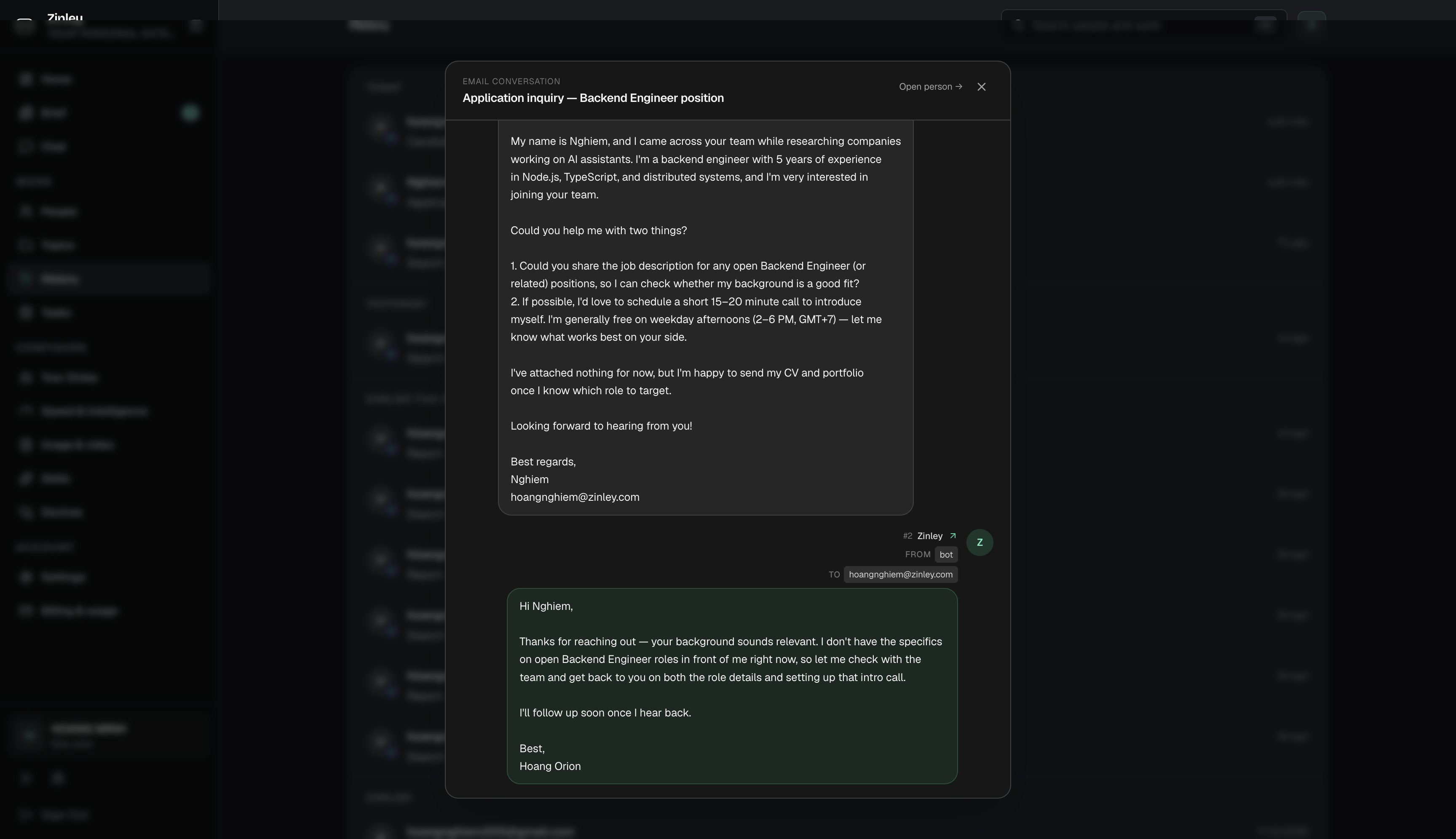
- It answers the sender — politely, usefully, and without overcommitting. In the screenshot above, a candidate asked for a job description and an intro call; Zinley thanked them, said it would check with the team, and promised a follow-up. No ghosting, no fake promises.
- It emails you a heads-up — a separate message in your inbox with the gist ("Candidate inquiry: Backend Engineer role — need your call") so the decision lands with you, not in a pile of unread mail.
The stranger gets a professional first response in minutes; you get a one-line decision to make instead of a thread to read. That's the whole idea.
The one-time bounce for strangers
If a stranger replies to an email your agent sent — a broadcast, a notification, an introduction — they get one short, polite note back explaining that this address isn't monitored for replies and pointing them to the right way to reach you. Their message doesn't reach the agent.
- The bounce is rate-limited to once per sender per 24 hours, so nobody gets caught in a reply loop.
- It threads into the existing conversation in their mail client rather than landing as a fresh, confusing message.
- It's also the recovery path for you: if you reply from a mailbox Zinley doesn't recognize yet, the bounce tells you how to add that address as trusted.
Blocked senders get no bounce at all. That's deliberate — see Trusted & blocked.
Attachments
Your agent can read what people send it.
- Up to 20 files per email, 25 MB each.
- Images, PDFs, documents, audio — all readable. Your agent can look at a screenshot, quote a contract, or summarize a deck.
- Executables are dropped silently —
.exe,.msi,.bat,.sh,.cmd,.ps1,.scr,.vbs, and friends never make it in. - If a file is rejected or oversized, your agent notices the gap and tells the sender what happened rather than pretending it read the file.
Very large images (over ~5 MB) can't be examined in detail — Zinley will ask the sender for a smaller version or a description of the part that matters.
Reply "STOP" to pause for 24 hours
Send an email whose entire body is STOP (or UNSUBSCRIBE) and Zinley stops handling
inbound email for your account for 24 hours, then resumes on its own. Case doesn't matter,
and a trailing period is fine.
- It has to be the whole message. "Please stop sending these" is read as a normal sentence, not a kill switch.
- Mail that arrives while paused is dropped, not queued.
- For a permanent change, set email replies to Never auto-reply in Email settings instead.
Where the mail shows up
Every thread your agent takes part in lands in the Emails tracker — subject, participants, the full transcript of what was actually sent, and an AI summary. Inbound mail also feeds your People profiles and Topics, and shows up in the next Daily brief.
Outward-facing replies wait for you by default. Decision autonomy starts at confirm, which means your agent proposes the send and you approve it. Switch it to auto in Agent setup if you'd rather it just go.
Related
- Your agent's email address — the address people write to.
- Trusted & blocked — promote a sender, or shut one out entirely.
- Email settings — when your agent replies, and whether you stay CC'd.
- Emails — the full record of every thread.
- People — what your agent remembers about each sender.